
Many people think mathematics is only useful in the classroom.
But mathematical thinking is one of the strongest foundations for building software, dashboards, automation systems, data tools, and business systems.
Mathematics Trains Problem Decomposition
Big problems become easier when they are broken into smaller parts.
That is one of the first things mathematics teaches you.
If a problem looks too large, you separate it into smaller pieces and work through it step by step.
Software works the same way.
A digital system may involve users, forms, validation, databases, notifications, reports, payments, permissions, and dashboards.
Trying to solve everything at once creates confusion.
Breaking things down creates clarity.
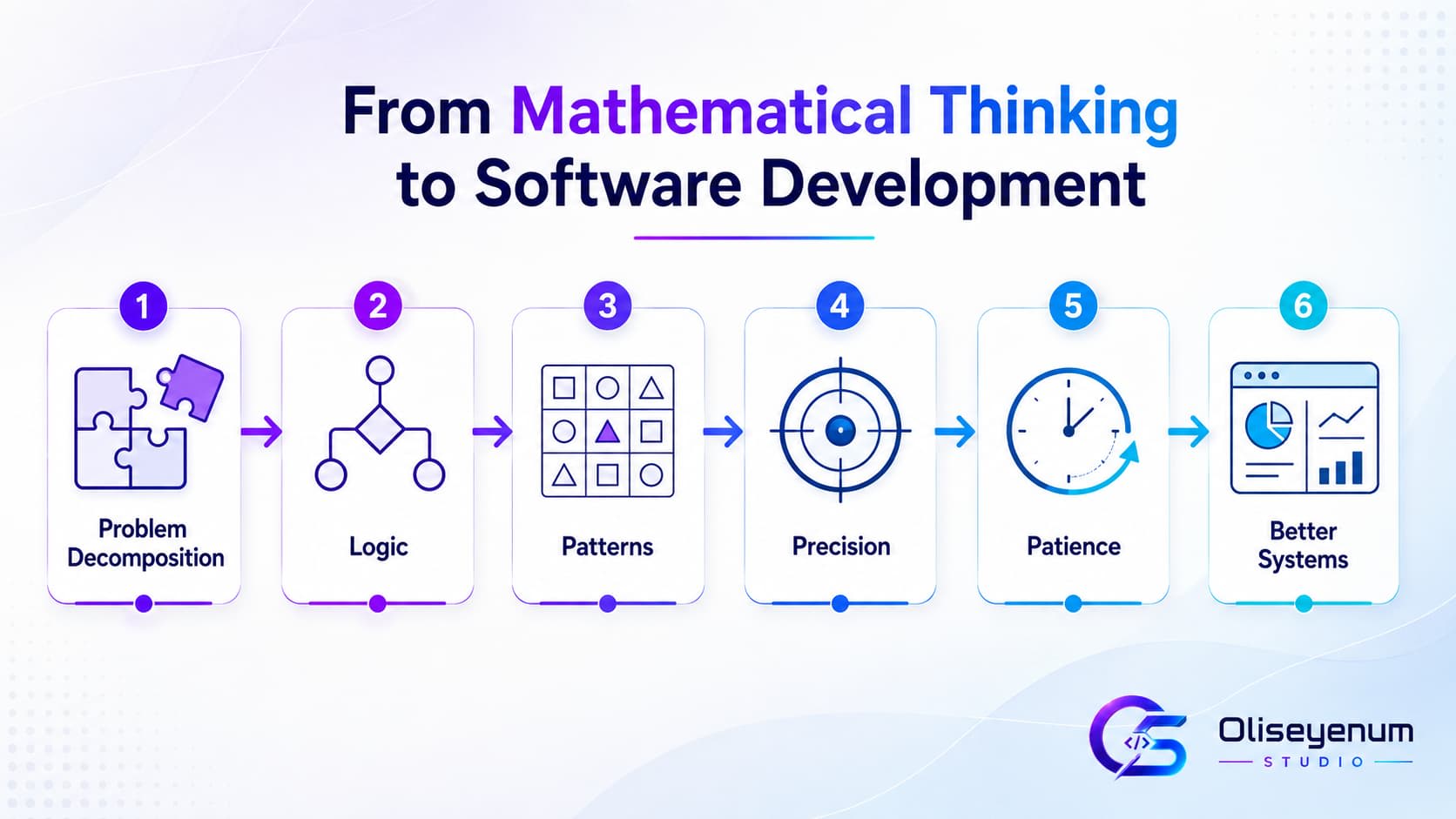
Software depends on conditions, rules, and processes.
If this happens, do that. If the user is signed in, show this. If payment is confirmed, unlock access. If the form is submitted, save the record and notify the business owner.
This is logic.
Mathematics trains you to think carefully about logic and consistency.
Mathematics Helps You Notice Patterns
Patterns matter in both education and technology.
In mathematics, you look for structure and relationships.
In software, you look for repeated behaviors, repeated user actions, and repeated business tasks that can be simplified.
This pattern recognition also helps when working with data.
A dashboard is useful because it helps people see patterns in what is happening.
Mathematics Encourages Precision
A small error in a formula can change the answer.
A small error in an application can affect data, user experience, payments, or the entire workflow.
Precision matters in:
Mathematics builds respect for careful work.
Mathematics Builds Patience
Not every problem makes sense immediately.
Sometimes you sit with it, test ideas, correct mistakes, and keep going.
That same patience matters in software development and teaching.
When building systems, rushing often creates fragile results.
When teaching students, rushing explanations often creates confusion.
Patience is part of clarity.
Why This Matters in My Work
As a mathematician, developer, and tutor, I carry the same principle into everything I build and teach:
understanding first, then execution.
That is true for students learning mathematics.
It is also true for businesses trying to build better systems.
A good system starts with understanding the problem clearly.
Final Thought
Mathematics and software may look like different worlds, but they are connected by structure, logic, patterns, precision, and problem-solving.
That is why mathematical thinking is not separate from what I do.
It is part of how I think, build, and teach.